Chamath posted this week: “Is on-premise the new cloud? I’m beginning to think yes. It’s the only way for companies to not blow themselves up and have some semblance of capability in an AI world.” Jason Fried dropped a link to Basecamp’s cloud exit and five words: “Saving us $10M, at least.”
Most people read this as a cost conversation. It’s not. Cost is the part that’s easy to measure. The structural problem underneath is harder to see and harder to fix. The cloud lets you rent compute and keep control. AI doesn’t offer that deal.
The cloud deal changed
Cloud worked because compute was deterministic. Both sides ran code. AWS ran millions of lines of service code. You ran your application. When something broke, you could trace it. Their bug or your bug, but someone’s bug, and the behavior was reproducible. The shared responsibility model worked because the boundary was clear. Provider secures the infrastructure; you secure what runs on it. Both sides knew which side of the line they were on.
AI breaks that. Not because there’s suddenly code you don’t control. That was always true in cloud. What’s new is behavior that isn’t traceable to anyone’s code in the traditional sense. A provider updates the model, and your system behavior changes. The model isn’t buggy. It’s probabilistic. Nobody wrote a line of code that says “produce this different output.” New failure modes show up without any deployment on your end. Pricing shifts once you’re locked in. Your data may be training their next competitive advantage. The model’s behavior isn’t infrastructure, and it isn’t your code. It’s a third thing, and it doesn’t fit on either side of the old responsibility boundary.
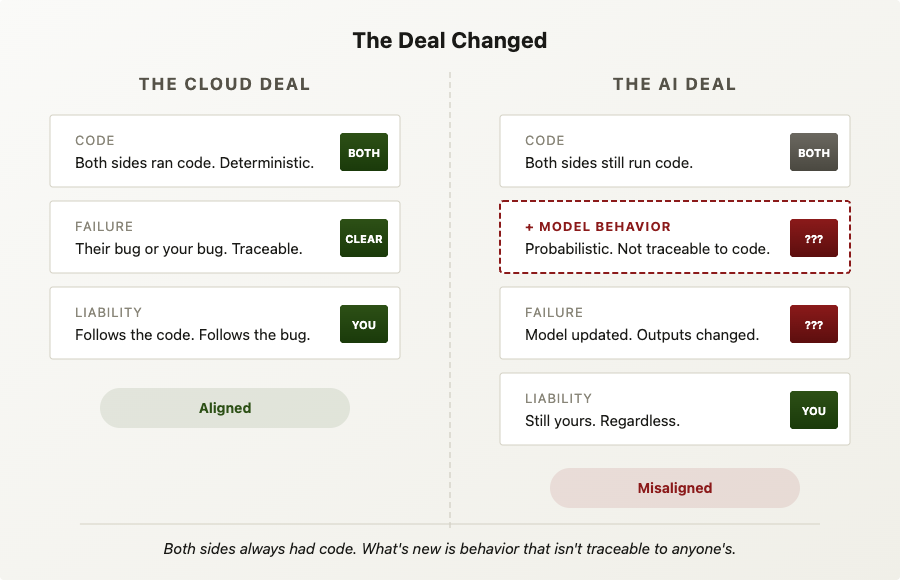
This isn’t renting infrastructure anymore. It’s renting capability. And the difference matters, because when AI becomes core to the product, whoever owns the capability layer owns the product. Everything else is a wrapper.
Liability doesn’t outsource
When your upstream model changes behavior and you violate a regulation, misprice risk, or produce unlawful output, that’s your problem. Not the API provider’s. Control and responsibility don’t decouple just because you didn’t train the weights.
Courts are already working through this, and the early results are clarifying.
In January 2026, the consolidated NYT v. OpenAI copyright litigation produced a discovery order compelling OpenAI to hand over 20 million anonymized ChatGPT logs. OpenAI had proposed the sample size itself, then tried to walk it back to keyword-filtered subsets. The court said no. Users who voluntarily submit conversations to a third-party platform have limited privacy protections over those interactions. Twenty million logs, 0.5% of the tens of billions OpenAI retains, and the court found that proportional.
Every conversation your team has with a hosted model is a record on someone else’s infrastructure, subject to someone else’s legal disputes.
Then on February 10, Judge Rakoff ruled in United States v. Heppner that 31 documents a defendant created using a commercial AI tool and shared with his defense attorneys aren’t privileged. Not attorney-client privilege, not work product. The court found “not remotely any basis” for protection. The AI platform isn’t an attorney; its terms disclaim any such relationship, and sending pre-existing unprivileged documents to a lawyer doesn’t retroactively create privilege. The government compared it to Google searches. Running a search and sharing results with your attorney doesn’t make the search history privileged.
Same direction, both cases. When you run your thinking through a third-party AI platform, you create discoverable records on infrastructure you don’t control, under terms you probably haven’t read carefully, with no privilege protection even if you later involve counsel.
Externalize capability. Retain liability.
Competing on rented capability
There’s a reason major retailers avoid AWS. Amazon is their competitor. Running your recommendation engine, pricing logic, or supply chain optimization on a competitor’s infrastructure isn’t philosophical. It’s operational. They see your usage patterns, your scale, your growth trajectories.
The same dynamic is showing up with AI providers. Build differentiated capabilities on a hosted model, and the provider has visibility into what you’re building and how. Your usage patterns become their product intelligence, whether or not they train on your data directly. You’re renting AI capabilities from the same companies you’re trying to compete with. Hard to build moats on someone else’s foundation.
Confidential compute solves one dimension
The obvious technical response to the privacy problem is confidential computing. Run the model inside a hardware enclave so even the infrastructure operator can’t see your data.
Moxie Marlinspike launched Confer in December. The Signal playbook applied to AI. End-to-end encrypted inference inside a Trusted Execution Environment. The host never sees your conversations. Architecturally private, not policy-private. As Marlinspike put it, AI chat logs reveal how you think, and once advertising arrives (it already has at OpenAI), “it will be as if a third party pays your therapist to convince you of something.”
Tinfoil takes a more general approach, building a confidential computing platform on NVIDIA’s Hopper and Blackwell GPUs with open-source verification and cryptographic attestation. They’re collaborating with Red Hat on open-source confidential AI infrastructure and recently joined the Confidential Computing Consortium. Privacy of on-prem, convenience of cloud, backed by hardware rather than promises.
Apple’s Private Cloud Compute is the big-company version. Extend the device security model to cloud inference with attestable guarantees about what code handles your request.
All serious work. All a long road.
The hardware foundations keep getting hit. Intel SGX has been battered by years of side-channel attacks. AMD SEV has had its own issues. Intel TDX, the newer play, just went through a joint security review with Google’s bug hunters that surfaced real problems. Each generation improves. None are yet where you’d stake regulatory compliance on the enclave boundaries holding against a motivated attacker with physical access.
But even if confidential compute fully matures, even if you can cryptographically guarantee nobody sees your data during inference, you’ve only solved one dimension of the problem.
Data privacy doesn’t fix model behavior. A provider pushes an update, your outputs change, and confidential compute didn’t help. Your data was private the whole time. Your system still broke.
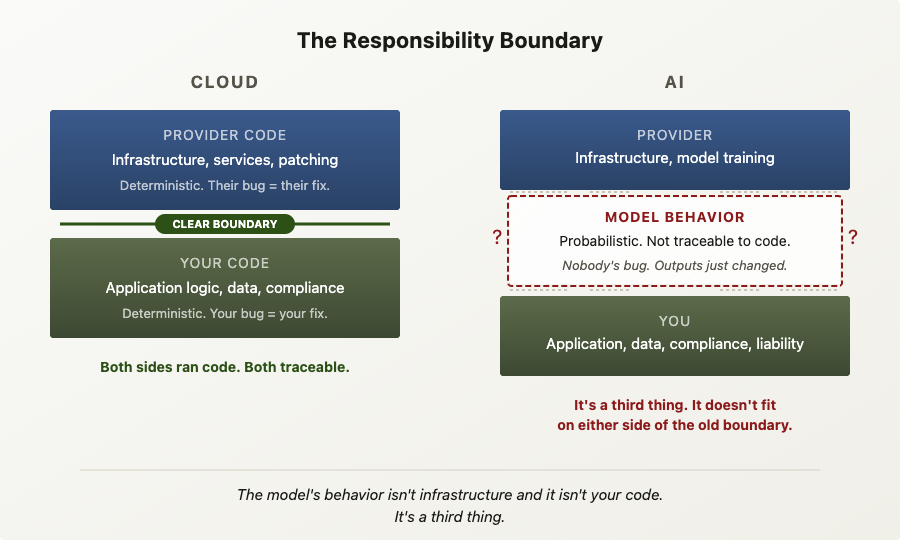
Privacy is necessary. Ownership is the harder problem.
The infrastructure is catching up
The historical objection to “just run it yourself” was operational. Cloud won because it made infrastructure someone else’s problem. APIs, elastic scaling, managed services, no procurement cycles. Going on-prem meant going backward on developer experience and velocity.
That gap is closing. Oxide builds rack-scale systems that bring cloud architecture to hardware you own. API-driven infrastructure, elastic storage, integrated networking. Not commodity servers you’re left to assemble, but a single integrated system purpose-built from hardware through operating system. They’ve raised roughly $300 million to date and their customers include Lawrence Livermore National Laboratory and CoreWeave.
Bryan Cantrill, Oxide’s CTO, resists the term “private cloud.” He calls it “on-premises elastic infrastructure” because private cloud historically meant duct-taping multi-vendor stacks together and hoping. Oxide was built from scratch, so the operational model actually works.
37signals proved the economics. Moving seven applications off AWS onto their own hardware saved $10 million over five years on a hardware investment that paid for itself in six months. But cost was always the easy argument. The harder one, the one Chamath is circling, is about control over what actually makes your product work. Not just the servers. The model versioning, the update cadence, the safety filters, the logging policy, and the alignment decisions. Capability evolution on your timeline, not someone else’s. Enterprise contracts can promise some of this. Version pinning, indemnification, non-training guarantees. But contractual assurances are not the same as technical control over capability evolution. A contract says they won’t change your model without notice. Ownership means they can’t.
The common middle ground is hybrid. Train in the cloud, run inference on-prem. That works for latency and cost. It doesn’t solve the ownership problem. If you’re still pulling model updates from an upstream provider, you’ve moved the compute but not the dependency. The failure mode is the same. It just happens on your hardware.
There’s a harder version of this objection. Model capabilities are still compounding. If you pin an open-weights model on your own rack for stability and control, but your competitor rides the frontier API curve, they’re accepting volatility in exchange for raw intelligence. Stability is the right metric for infrastructure. For capability, sometimes you need the smartest model available, even if it’s unpredictable. The on-prem bet only works long-term if open-weights models keep pace with closed-source APIs. If they don’t, ownership becomes a stability play at the cost of falling behind the intelligence frontier.
And for most companies, training or fine-tuning a frontier model isn’t realistic. They don’t have the data, the talent, or the compute budget. The API dependency isn’t a bad decision. It’s the only one available. Which means this isn’t a trade-off most organizations can avoid. It’s one they need to understand clearly, because the costs of not understanding it are compounding in courtrooms and competitive markets right now.
The access problem
If the answer to AI privacy and control is “own the infrastructure,” we already know who can afford that and who can’t.
Enterprises with budget and technical depth will run their own inference on their own hardware. They’ll pin model versions, control their data, keep their logs out of other people’s lawsuits. The well-resourced get privacy, control, and capability independence.
Everyone else gets the free tier. Their conversations live on someone else’s servers, train someone else’s models, show up in someone else’s discovery obligations, and get monetized through advertising that knows exactly how they think. This is the most intimate technology ever built, and access to the private version of it tracks directly to the ability to pay.
This pattern isn’t new. Same split as healthcare, education, and legal representation. But AI sharpens it because the privacy gap isn’t about what you can afford to buy. It’s about what you’re forced to reveal by using the product at all.
The consumer version plays out in personal AI. Local models on personal hardware will happen. They’re already happening. But the timeline to frontier parity is longer than the optimists claim, and the cost of the hardware isn’t trivial. The people who can afford local inference or premium privacy tiers will opt out of the surveillance model. Everyone else won’t have the choice.
This is where confidential compute matters most. Not for enterprises, who solve the problem with hardware and headcount, but for the everyone-else case. If Confer or Tinfoil, or Apple PCC can make private inference the default rather than the premium option, if the cryptographic guarantees get strong enough that you don’t need to own the rack to own your data, that changes the access equation.
It doesn’t solve the capability ownership problem. Companies building products on AI will still need to control their model stack. But it could mean that using AI doesn’t require surrendering the record of how you think to whoever runs the server.
That’s one leg of the problem. A meaningful one. The other legs, model behavior stability, capability independence, and liability alignment, still require ownership for anyone building on top of these systems.
Where this goes
The cloud era trained everyone to think of infrastructure as a commodity you rent. For deterministic compute, that was right. The cycles did what you told them. Responsibility was clear.
AI couples capability to liability in a way cloud computing never did. The compute isn’t just running your logic. It’s making decisions, generating records, and creating obligations that follow you regardless of where the model runs or who trained it.
Ownership is becoming the default for anything that touches the capability layer. The infrastructure to make that viable is catching up. The open-weights ecosystem has to keep pace for it to work. And the question of who gets access to the private, controlled version of AI versus who’s stuck with the surveilled version will define the next decade of policy fights.
Renting capability means renting decisions you don’t control while keeping consequences you can’t outsource.
Pingback: We Built It With Slide Rules. Then We Forgot How. | UNMITIGATED RISK