Let’s Encrypt announced DNS-PERSIST-01 support this week. That is worth noting on its own. But the announcement landed in a way that made me want to trace the longer arc, because what DNS-PERSIST-01 represents is not just a new ACME method. It is the last piece of a transition that took the ecosystem roughly three decades to complete.
That transition was simple in concept and genuinely hard in practice. Stop guessing who answers the phone and start proving who controls the namespace.

What “domain control validation” actually meant in the early days
If you were issuing or auditing certificates in the early web era, domain control validation was less a cryptographic proof than an act of institutional faith. The certificate authority (CA) would send a challenge to webmaster@, admin@, or hostmaster@ at the subject domain, or sometimes look up a fax number in WHOIS and send something there. If a human responded, the certificate got issued.
The model made a bet, a bet that there was a stable, security-relevant human role behind each domain, reachable through a stable channel, and that the person on the other end was both authorized and paying attention.
That bet was always shakier than it looked. What actually happened over time was that the alias went to a ticketing system, or an outsourcer, or a shared mailbox that someone forgot to audit, or just the wrong person entirely. The certificate still got issued. The CA had checked the box. No one had actually verified control of anything.
The worst failures in this period were not exotic cryptographic breaks. They were governance failures and operational drift. The “webmaster takeover” class of problem. The role stopped being real long before the method stopped being allowed. The Baseline Requirements, the industry rules governing what certificate authorities are allowed to do, carried these validation approaches forward because nobody volunteers to own the deprecation, and someone always depends on the thing you want to kill.SC-080 and SC-090 are essentially the CA/Browser Forum (CABF) writing down, in balloted form, what practitioners had already known for years, that being able to be reached at a business address does not demonstrate domain control.
The thing that made the real fix possible
It is easy to look at ACME, the protocol that powers automated certificate issuance, and treat it as a purely technical improvement. It was. But the reason it became viable as a default assumption had as much to do with deployment reality as with protocol design.
In 2014, roughly 30% of web traffic was HTTPS. Mozilla telemetry puts it above 80% globally by late 2024, with North America around 97%. Chrome’s numbers show the same shape, climbing from the low 30s in 2015 to 95-99% by 2020 and plateauing since.
That matters because ACME’s endpoint-based methods depend on actually reaching the endpoint. HTTP-01 proves control by serving a signed token over HTTP at a well-known path on port 80. TLS-ALPN-01 proves control by completing a TLS handshake on port 443 using a dedicated protocol extension and a special validation certificate, with no HTTP handling required. That distinction matters in practice; TLS-ALPN-01 exists specifically for hosting providers, CDNs, and TLS-terminating load balancers who want to validate at the TLS layer without routing validation traffic through to their backends. If port 80 is blocked or you are terminating TLS before HTTP ever reaches your application, TLS-ALPN-01 is the right tool. If you have a publicly reachable web server and port 80 is open, HTTP-01 is simpler.
Both are bootstrap proofs and you can establish domain control without DNS write automation, which matters for the long tail of deployments where DNS is locked down or outsourced in ways that make safe automation difficult. In 2014, assuming you could reach a public endpoint was optimistic. By 2024, the population of sites that cannot serve a response over HTTP or TLS is small enough to be the exception. The web converged on HTTPS fast enough that endpoint-based validation became the reasonable default.
HTTP-01 is also, almost certainly, the last insecure-by-design method that will survive long term, and it will survive for structural rather than technical reasons. There is a bootstrap problem – TLS-ALPN-01 requires TLS already be deployed and configurable at the edge, but if you are getting a certificate because you do not yet have TLS, you cannot use TLS-ALPN-01 to get it. HTTP-01 is how you break out of that loop. More durable than the bootstrap problem, though, is the org chart problem. In large organizations, the web team controls the servers, the network team owns port policies, the DNS team owns the zone, and security owns the TLS infrastructure decisions. None of them individually have the full set of permissions to deploy any other method without coordination. But the web team can serve a token file over port 80 without asking anyone. HTTP-01 wins by default, not because it is the right answer, but because it is the answer that requires the fewest cross-team conversations. That dynamic is unlikely to change, which means HTTP-01 will probably remain the method of last resort indefinitely, insecure channel and all.
DNS-01, and why scale broke it
DNS-01 changed the question from “who answers this email” to “who can write to this DNS zone.” That is a meaningfully better question. DNS is not a signal that you control the domain. It is the domain.
The operational reality, though, is that DNS automation means DNS API credentials distributed across issuance pipelines, renewal workflows, and whatever tooling you are running at the edge. At modest scale that is manageable. At high volume, across large platforms, IoT deployments, and multi-tenant environments, the recurring DNS write per renewal starts to look like both a performance constraint and a credential sprawl problem.
The CNAME delegation pattern that became common was a partial answer, point _acme-challenge.<domain> at a zone you control more tightly, and do the proof there. It worked. It also created a new problem, multiple independent solvers fighting over a shared label.
DNS-ACCOUNT-01, which solved the CNAME collision and nothing else
DNS-ACCOUNT-01 exists to solve that specific problem. By scoping the validation label to the ACME account rather than leaving it shared, multiple delegated pipelines can coexist without colliding. Two independent issuance systems, two different cloud providers, parallel solvers during a migration. They all get their own label and can run without coordinating.
It is intentionally narrow. It does not change the underlying rhythm of fresh proof per issuance. The label is persistent, the proof is still ephemeral. A new token per order, a new DNS write per renewal. The change is only where the proof lives, so delegation can scale cleanly. DNS churn remains, because that was not the problem DNS-ACCOUNT-01 was trying to solve.
In hindsight, that narrowness reflects the world it was designed for. Certificate validity was still measured in years, then in 398 days. Renewals were infrequent enough that requiring fresh DNS proof per issuance was a manageable cost. The credential distribution problem existed, but it was not yet acute. If DNS-ACCOUNT-01 had been designed in a world where certificates expire every 47 days, which is where the CABF is now taking us, it almost certainly would have looked a lot more like DNS-PERSIST-01 from the start. That is not a criticism. You cannot see the 47-day problem from inside a 398-day world.
DNS-PERSIST-01, which the short-validity world actually requires
The CA/Browser Forum’s ongoing push to shorten maximum certificate validity, from years down to 398 days and now trending toward 47, makes the recurring-proof model increasingly painful for everyone, not just operators running at high volume. At 398-day validity, a DNS write per renewal is a minor operational cost. At 47 days, you are writing to DNS eight times a year per certificate, across every certificate in your fleet, with API credentials that have to live somewhere in that pipeline. That is not a scaling problem. That is a design problem.
The more important point is that DNS-PERSIST-01 is simply the better tool for anyone who has DNS access and a CA that supports it, regardless of volume. It subsumes what DNS-01 and DNS-ACCOUNT-01 each solve – the CNAME collision problem goes away because each account’s standing authorization is already scoped, and the credential churn problem goes away because there is no recurring write.
The useful analogy here is passwords versus passkeys. Passwords require you to re-prove the secret on every authentication. Passkeys establish a cryptographic binding once and derive proof from it. Every DNS-based ACME method before DNS-PERSIST-01 worked like a password, prove control again, on this order, right now. DNS-PERSIST-01 works like a passkey; the binding is established, scoped, and cryptographically tied to your ACME account key. You do not re-prove the same thing on every renewal. You prove you still hold the key.
Instead of proving control on every renewal cycle, you establish a standing authorization record bound to your ACME account and the CA. Set it once. Reuse it across renewals. The CABF formalized this direction in SC-088v3, which added the DNS TXT Record with Persistent Value method to the BRs.
This is not a shortcut. The standing authorization is scoped, can carry expiration, and is explicitly tied to an ACME account key. The attack surface moves from the repeated DNS transaction to the account key itself, which is the right place for it. That is why Let’s Encrypt is being deliberate, Pebble (the reference ACME test server) support is in place, client support is in progress, and the staged rollout is planned for 2026. The scope controls around wildcard policy and authorization lifetime are part of the design, not afterthoughts.
What it eliminates is the recurring DNS write requirement that turned high-volume issuance into a credential distribution problem. In a world trending toward 47-day certificates, that is not a nice-to-have. It is the method that makes the new validity regime operationally survivable for anyone running at real scale.
What actually changed
The webmaster era died because the webmaster role died. The person who answered webmaster@ in 1995 was plausibly the person responsible for the domain. By 2010, that alias might go anywhere. By 2020, it was a cassette tape. Technically still a format, functionally forgotten.
This is the same pattern that gave us a decade of SIM-swapping attacks. SMS was a convenient channel, so the industry conscripted it into an authentication role it was never designed for, and held it there long after the threat model had outgrown the assumption. Nobody decided email-to-webmaster or SMS were the right security primitives for what they were being asked to do. They were just there, they mostly worked, and changing them had cost. The failures were predictable in retrospect and ignored in practice until the losses became undeniable.
The ACME methods work because they measure what they claim to measure. HTTP-01 proves you can respond at the endpoint. DNS-01 proves you can write to the zone. TLS-ALPN-01 proves you can complete a handshake. Technical controls, not institutional proxies.
DNS-PERSIST-01 is the mature form of that idea, a standing proof of control that does not require re-proving the same thing every 90 days at the cost of DNS churn and credential distribution. It is also the method that answers the question the old system was never actually asking. The old system broke because standing assumptions about institutional stability turned out not to hold. The new system makes the standing assumption explicit, scoped, bound to a cryptographic identity, and revocable.
That is not the same mistake. That is the lesson applied.
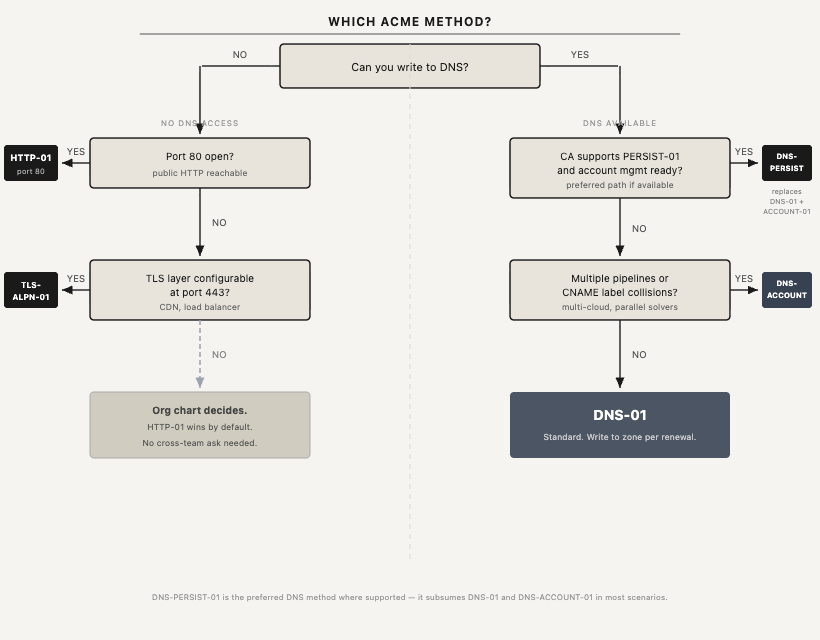
Start here when choosing a method. If you cannot touch DNS and port 80 is open, HTTP-01 is the simplest path. If port 80 is blocked or you are terminating TLS before HTTP reaches your application, TLS-ALPN-01 validates at the TLS layer without touching HTTP handling. If you need wildcard coverage or your edge is not publicly reachable at all, DNS-01 is the right tool. If you are running multiple independent pipelines against the same domain and CNAME delegation is creating label collisions, DNS-ACCOUNT-01 solves that without changing anything else. And if you are renewing at volume in a world trending toward 47-day validity, DNS-PERSIST-01 is the method that does not eventually break you, not because the others are wrong, but because repeated proof per renewal was designed for a renewal cadence that no longer exists.
In practice, large organizations often find themselves in a catch-22 that makes the decision for them. TLS-ALPN-01 requires TLS to already be deployed and configurable at the edge, but you need the certificate to deploy TLS in the first place. DNS-01 requires writing to the zone, but DNS is owned by a different team, and the change process takes weeks. DNS-PERSIST-01 requires standing up ACME account management, but that is a security infrastructure decision that needs approval. Meanwhile, the web team controls the servers and can serve a token file over port 80 today. So HTTP-01 it is, not because anyone evaluated the options and chose it, but because it was the only method where a single team had all the permissions needed to complete validation without a cross-functional project. The decision tree above describes the technically correct path. The org chart usually picks a different one.
Like most security improvements, the arc from fax-based DCV to persistent cryptographic authorization took longer than it should have, the gap between knowing something is broken and replacing it is always larger than it looks from the outside. But the trajectory is now clear that domain control validation means proving control, not guessing at it.