Talent Isn’t a Security Strategy

One of the best parts of Black Hat is the hallway track. Catching up with friends you’ve known for years, swapping war stories, and pointing each other toward the talks worth seeing. This year I met up with a friend who, like me, has been in the security world since the nineties. We caught up in person and decided to sit in on a session about a new class of AI attacks.

We ended up side by side in the audience, both leaning forward as the researchers walked through their demo. Ultimately, in the demo, a poisoned Google Calendar invite, seemingly harmless, slipped instructions into Gemini’s long-term memory. Later, when the user asked for a summary and said “thanks,” those instructions quietly sprang to life. The AI invoked its connected tools and began controlling the victim’s smart home [1,2,3,4]. The shutters opened.

We glanced at each other, part admiration for the ingenuity of the researchers and part déjà vu, and whispered about the parallels to the nineties. Back then, we had seen the same basic mistake play out in a different form.

When I was working on Internet Explorer 3 and 4, Microsoft was racing Netscape for browser dominance. One of our big bets was ActiveX, in essence, exposing the same COM objects designed to be used inside Windows, not to be exposed to untrusted websites, to the web. Despite this, the decision was made to just do that with the goal of enabling developers to create richer, more powerful web applications. It worked, and it was a security disaster. One of the worst examples was Xenroll, a control that exposed Windows’ certificate management and some of the cryptographic APIs as interfaces on the web. If a website convinced you to approve the use of the ActiveX control, it could install a new root certificate, generate keys, and more. The “security model” amounted to a prompt to confirm the use of the control, and a hope that the user would not be hacked through the exposed capabilities, very much like how we are integrating LLMs into systems haphazardly today.

Years later, when I joined Google, I had coffee with my friend David Ross. We had both been in the trenches when Microsoft turned the corner after its own string of painful incidents, introducing the Security Development Lifecycle and making formal threat modeling part of the engineering process. David was a longtime Microsoft browser security engineer, part of MSRC and SWI, best known for inventing and championing IE’s XSS Filter. He passed away in June 2024 at just 48.

I told him I was impressed with much of what I saw there, but disappointed in how little formal security rigor there was. The culture relied heavily on engineers to “do the right thing.” David agreed but said, “The engineers here are just better. That’s how we get away with it.” I understood the point, but also knew the pattern. As the company grows and the systems become more complex, even the best engineers cannot see the whole field. Without process, the same kinds of misses we had both seen at Microsoft would appear again.

The gaps between world-class teams

The promptware attack is exactly the sort of blind spot we used to talk about. Google’s engineers clearly considered direct user input, but they didn’t think about malicious instructions arriving indirectly, sitting quietly in long-term memory, and triggering later when a natural phrase was spoken. Draw the data flow, and the problem is obvious, untrusted calendar content feeds into an AI’s memory, which then calls into privileged APIs for Workspace, Android, or smart home controls. In the SDL world, we treated all input as hostile, mapped every trust boundary, and asked what would happen if the wrong thing crossed it. That process would have caught this.

The parallel doesn’t stop with Google. Microsoft’s Storm-0558 breach and the Secure Future Initiative that followed came from the same root cause. Microsoft still has world-class security engineers. But sprawling, interconnected systems, years of growth, and layers of bureaucracy created seams between teams and responsibilities. Somewhere in those seams, assumptions went unchallenged, and the gap stayed open until an attacker found it.

Google’s core security team is still exceptional, and many parts of the company have comparable talent. But as at Microsoft, vulnerabilities often appear in the spaces between where one team’s scope ends, another begins, and no one has the full picture. Complexity and scale inevitably create those gaps, and unless there is a systematic process to close them, talent alone cannot cover the field. These gaps are more than organizational inconveniences — they are where most serious security incidents are born. It’s the unowned interfaces, the undocumented dependencies, and the mismatched assumptions between systems and teams that attackers are so good at finding. Those gaps are not just technical problems, they are business liabilities. They erode customer trust, draw regulator attention, and create expensive, slow-motion incidents that damage the brand.

We have seen this before. SQL injection was once the easiest way to compromise a web app because developers concatenated user input into queries. We didn’t fix it by training every developer to be perfect. We fixed it by changing the defaults, adopting parameterized queries, safe libraries, and automated scanning. Prompt injection is the same shape of problem aimed at a different interpreter. Memory poisoning is its stored-XSS equivalent; the payload sits quietly in state until something triggers it. The lesson is the same: make the safe way the easy way, or the vulnerability will keep showing up.

Security research has a long history of starting with this mindset, not trying to dream up something brand new but asking where an old, well-understood pattern might reappear in a new system. Bleichenbacher’s 1998 RSA padding oracle didn’t invent the idea of exploiting oracles in cryptography; it applied it to SSL/TLS in a way that broke the internet. Then it broke it again in 2017 with ROBOT, and again with various other implementations that never quite learned the lesson. Promptware fits the same mold: a familiar attack, just translated into the LLM era.

The cycle always ends the same way

This is the innovation–security debt cycle. First comes the rush to ship and out-feature the competition. The interest compounds, each shortcut making the next one easier to justify and adding to the eventual cost. Then the debt builds as risk modeling stays informal and talent carries the load. Then comes the incident that forces a change. Finally, security becomes a differentiator in mature markets. ActiveX hit Stage 3. Microsoft’s Storm-0558 moment shows it can happen again. AI agents are in Stage 2 now, and promptware is the warning sign.
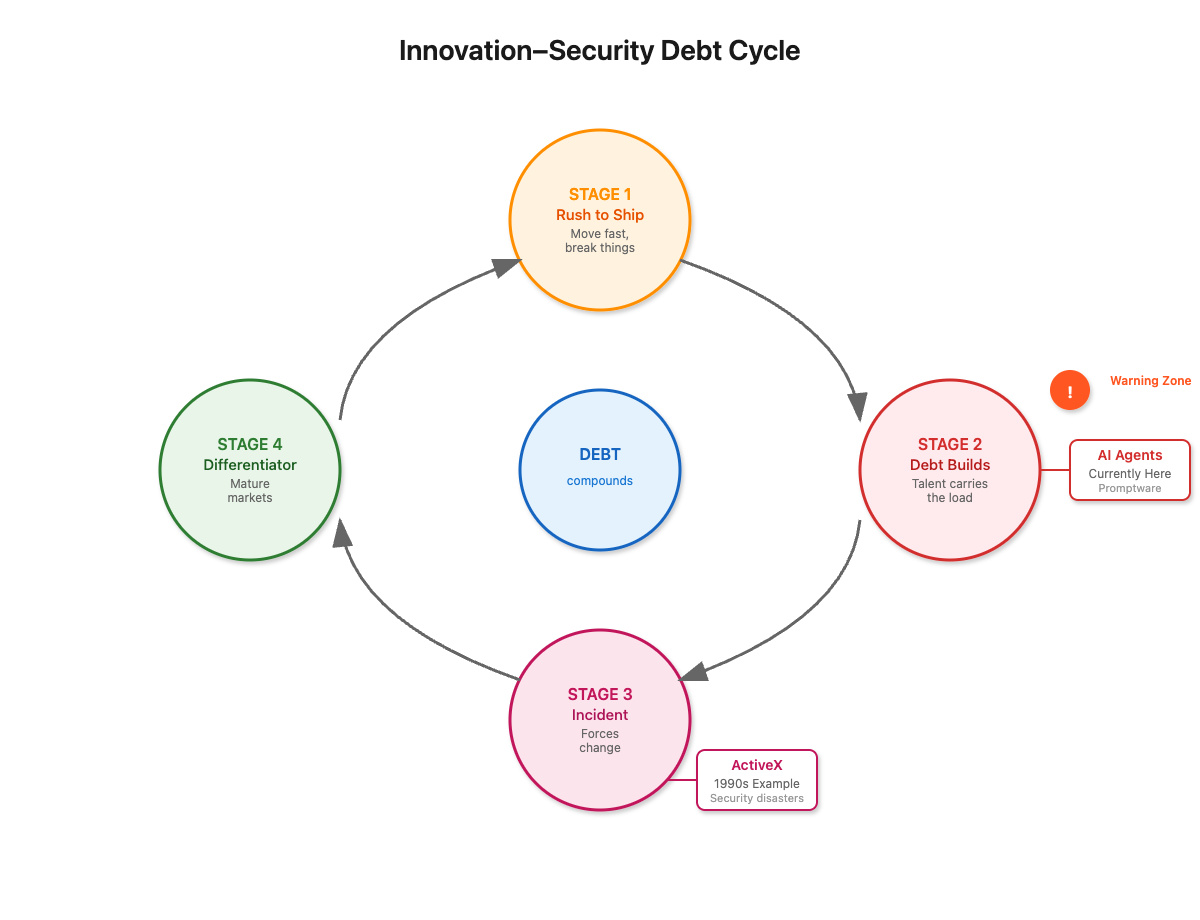
While the pattern is the same, the technology is different. ActiveX exposed specific platform capabilities in the browser, but AI agents can hold state, process inputs from many sources, and trigger downstream tools. That combination means a single untrusted input can have a much larger and more unpredictable blast radius. The market pressure to be first with new capabilities is real, but without mature threat modeling, security reviews, and safe defaults, that speed simply turns into compounding security debt. These processes don’t slow you down foreve, they stop the debt from compounding until the cost is too high to pay.

When you are small, a high-talent team can keep the system in their heads and keep it safe. As you grow, complexity expands faster than you can hire exceptional people, and without a systematic process, blind spots multiply until an incident forces you to change. By then, the trust hit is public and expensive to repair.

AI agents today are where browsers were in the late nineties and early 2000s, enormous potential, minimal systemic safety, and an industry sprinting to integrate before competitors do. The companies that make the shift now will own the high-trust, high-regulation markets and avoid the expensive, embarrassing cleanup. The ones that don’t will end up explaining to customers and regulators why they let the same old mistakes slip into a brand-new system. You can either fix it now or explain it later, but the clock is running.

History Doesn’t Repeat, But It Rhymes: The AI Panic Edition

When my parents were young, the message was simple. Do not have too many kids. By the 1980s, they were told, the world would be out of food. The oceans would be empty, the fields barren, and billions would starve.

It didn’t happen.

Not because of enlightened environmental policy or a coordinated global rescue plan. Scarcity meant higher prices. Higher prices meant profit. Profit meant more land under cultivation, more seeds developed, more fertilizer produced, more ships built, and more grain moved wherever it could be sold or used as political leverage. Capitalism turned scarcity into action because there was money to be made. Fertility rates fell because cities and industrial jobs changed family economics, not because a UN pamphlet said so. The system adapted chaotically, imperfectly, creating new problems along the way, but it adapted fast enough to outrun the doomsday clock.

Fast forward to 2025. DeepSeek releases a small, efficient AI model, and the hot takes fly. “This will kill Nvidia. Nobody will need giant GPUs anymore.” The stock dips on fears that small models will replace big ones. Meanwhile, another meme makes the rounds, “Don’t learn to program. AI will do it all.”

Same flawed logic as the famine forecasts. Straight-line projections in a complex, adaptive system.

Cheaper AI means lower costs. Lower costs mean more users. More users mean more use cases, and more use cases mean more aggregate demand for compute. Capitalism loves efficiency because efficiency breeds new markets. Nvidia won’t sell fewer chips in that world. They’ll sell more, to more buyers, in more configurations.

The idea that AI will kill programming jobs is just the latest in a long line of bad predictions. High-level languages were supposed to do that. So were compilers. So were frameworks, IDEs, and low-code tools. Each one lowered the cost of creation, and when the cost of creation goes down, the number of things worth creating goes up. That expansion creates more work, not less. AI will follow the same pattern.

The speed is different this time, admittedly. AI capabilities are advancing faster than previous technologies, and the potential scope is broader. But markets adapt faster when the stakes are higher, and the stakes have never been higher. The same forces that drove rapid agricultural innovation in the face of predicted famine will drive even faster adaptation in the face of AI disruption.

I’ve seen this panic up close. My middle child, who has strong math skills and is a thoughtful problem solver, is planning to earn a Master’s in Computer Engineering. He asked if that was a mistake. I told him no. Hot takes at this scale are almost always wrong. The system adapts in ways first-order forecasts miss, and the people who understand the tools are the ones who thrive when it does.

Doom sells better than nuance. “AI will end all jobs” gets more clicks than “jobs will change in unpredictable ways.” Hot takes spread because they’re clean and simple. But complexity is where the truth lives, and where the opportunity hides.

In the 1960s, the refrain was “Don’t have kids, the world will starve.” Today, it’s “Don’t learn to code, AI will do it all.” Both ignore the same truth, when there’s money to be made, markets adapt, and the winners are the ones who adapt with them.

When Automation Becomes Bureaucracy

How well-intentioned automation traps people in frustrating loops, and what we can do to stop it.

My wife is from Belarus. On one of my first visits there, I had my first real exposure to what extreme bureaucracy looked like.

Each time I visited a new city, if I stayed more than a certain number of days, I had to register with the police. The process could take an entire day and involved going to a bank to deposit money into the police branch’s account, then returning with a receipt.

One time, we tried to withdraw the remaining cash and close a bank account. We spent the entire day waiting in line after line, at one bank location after another. In the end, we gave up because the opportunity cost was greater than the amount of money we were trying to reclaim.

Need to pay for passport photos? You could not pay in cash, I assume due to fear of fraud and graft; you had to go to the bank, transfer money to the photo shop, and bring back a receipt to prove it.

What struck me was that I was the only one who found this painful. Everyone else accepted it as normal. Endless lines, paperwork, and procedural steps that seemed arbitrary and counterproductive.

So why am I writing about this? This morning I was reflecting on recent experiences changing flights and helping my parents with their Comcast subscription. Over and over, I ran into automation that was supposed to make things easier but actually made things worse.

I tried to change a flight from London to Seattle on Delta. Since it was a codeshare with Virgin, the website couldn’t handle it. I called the support line and got pushed through a phone tree that aggressively tried to send me back to the website. The site still didn’t work. I called back and asked to speak with someone and was routed to a virtual assistant that did nothing but run keyword searches on the help site. Eventually, I got connected to a lower-tier agent who told me the $350 fare difference I saw online wasn’t correct and that it would be $3,000. I pushed back until I reached someone who could actually help. They made the change. The entire process took nearly two hours.

Then there was Comcast. My aging parents have been living with me, and I’ve been helping with their bills. I noticed their TV and internet service had crept up to $350 per month. It was the result of expired deals, supposed discounts that added phone lines they never used, and a long list of tactics designed to get people to pay more for services they didn’t want. Fixing it took well over an hour, and once again I had to fight through automation before talking to someone who would do anything.

Not all automation becomes bureaucracy. My USAA mobile app lets me deposit checks instantly, transfer money in two taps, and reach a human agent with a button press when something goes wrong. It avoids the bureaucracy trap because it was designed around what I actually need to do, with seamless escalation when the automation isn’t enough.

There’s a saying that comes to mind: don’t attribute to malice what can be explained by ignorance. The people who built these systems were probably trying to help. But they were judged by what they shipped and time saved on support calls, not by whether their systems improved user experience.

So what does this mean? When we build systems like these, we need to start by deciding how we will define and measure success. That question should come at the beginning, not the end. It needs to shape how the system is designed, not just how it is reported.

Too often, we optimize for metrics that are easy to measure, like time on call or tickets closed, rather than the experience we’re actually trying to create. Instead, consider measuring success by how empowered customers feel, not how fast they hang up. Once the system is live, we have to come back and test our assumptions. That means checking whether it actually helps users, not just whether it saves time or reduces support volume. One way to do this is to regularly review customer satisfaction and compare it to the experience we intended to create. If it isn’t working, we need to change how the system behaves and what we measure.

This is especially important as we start building with AI. These systems can develop unexpected behaviors. Take Air Canada’s chatbot, which confidently told a customer he could buy a full-price ticket to his grandmother’s funeral and apply for a bereavement discount within 90 days after travel. This was completely wrong. When the customer tried to get the promised refund, the airline refused and even argued the chatbot was a “separate legal entity responsible for its own actions.” Unlike a phone tree that just frustrates you, the AI gave authoritative-sounding but fabricated policy information. The airline probably measured success by how many conversations the AI handled without escalating to humans, not realizing that customers who got wrong answers often just give up rather than keep fighting.

What we choose to measure and how fast we respond when something goes wrong matters more than ever. Once these systems are deployed, they don’t just carry our assumptions forward. They reinforce them. They make it harder to see when the original design was flawed, because the automation itself becomes the norm.

The goal should always be to reduce friction and make life easier for real people, not just to make things more efficient for the teams who built the system. The best systems I’ve used made it easy to talk to a human when I needed to, and didn’t treat automation as a wall to hide behind.

If we lose sight of that, we risk recreating the same kind of bureaucracy I saw years ago, only now it will be faster, more rigid, and much harder to argue with.

How a $135 Billion Fraud Bootstrapped America’s Digital Identity System

I was doing some work on readying a launch for our integration with mDL authentication into one of our products when I realized I finally had to deal with the patchwork of state support. California? Full program, TSA-approved, Apple Wallet integration. Texas? Absolute silence. Washington state, practically ground zero for tech, somehow has nothing.

At a glance the coverage made no sense until I started thinking deeper. Turns out we accidentally ran the largest identity verification stress test in history, and only some states bothered learning from it.

Between 2020-2023, fraudsters systematically looted $100-135 billion from unemployment systems using the most basic identity theft techniques. The attack vectors were embarrassingly simple: bulk-purchased stolen SSNs from dark web markets, automated claim filing, and email variations that fooled state systems into thinking [email protected] and [email protected] were different people.

The Washington Employment Security Department was so overwhelmed that they had computers auto-approve claims without human review. Result? They paid a claim for a 70-year-old TV station being “temporarily closed” while it was broadcasting live.

California got hit for $20-32.6 billion. Washington lost $550-650 million. The fraud was so widespread that one Nigerian official, Abidemi Rufai, stole $350,763 from Washington alone using identities from 20,000+ Americans across 18 states.

What nobody anticipated, this massive failure would become the forcing function for digital identity infrastructure. Here’s the thing about government security. Capability doesn’t drive adoption, pain does. The Real ID Act passed in 2005. Twenty years later, we’re still rolling it out. But lose a few billion to Nigerian fraud rings? Suddenly digital identity becomes a legislative priority.

The correlation is stark:

StateFraud LossesmDL Status
California$20-32.6BComprehensive program, Apple/Google integration
Washington$550-650MNothing (bill stalled)
Georgia$30M+ prosecutedRobust program, launched 2023
TexasUnder $1B estimatedNo program
New YorkAround $1-2BLaunched 2025

States that got burned built defenses. States that didn’t, didn’t. This isn’t about technical sophistication. Texas has plenty of that. It’s about the political will created by public humiliation. When your state pays unemployment benefits to death row inmates, legacy approaches to remote identity verification stop being defensible.

Washington is the fascinating outlier. Despite losing over $1 billion and serving as the primary target for international fraud rings, they still have no mDL program. The bill passed the Senate but stalled in the House. This tells us something important: crisis exposure alone isn’t sufficient. You need both the pain and the institutional machinery to respond.

The timeline reveals the classic crisis response pattern. Fraud peaked 2020-2022, states scrambled to respond 2023-2024, then adoption momentum stalled by mid-2024 as crisis memory faded. But notice the uptick in early 2025—that’s Apple and Google entering the game.

In December 2024, Google announced its intent to support web-based digital ID verification. Apple followed with Safari integration in early 2025. By June, Apple’s iOS 26 supported digital IDs in nine states with passport integration. This shifts adoption pressure from crisis-driven (security necessity) to market-driven (user expectation).

When ~30% of Americans live in states with mDL programs and Apple/Google start rolling out wallet integration this year, that creates a different kind of political pressure. Apple Pay wasn’t crisis-driven, but became ubiquitous because users expected it to work everywhere. Digital identity in wallets will create similar pressure. States could rationalize ignoring mDL when it was ‘just’ about fraud prevention. Harder to ignore when constituents start asking why they can’t verify their identity online like people in neighboring states.

We’re about to find out whether market forces can substitute for crisis pressure in driving government innovation. Two scenarios. Consumer expectations create sustainable political pressure, and laggard states respond to constituent demands. Or only crisis-motivated states benefit from Apple/Google integration, creating permanent digital divides.

From a risk perspective, this patchwork creates interesting attack surfaces. Identity verification systems are only as strong as their weakest links. If attackers can forum-shop between states with different verification standards, the whole federation is vulnerable. The unemployment fraud taught us that systems fail catastrophically when overwhelmed.

Digital identity systems face similar scalability challenges. They work great under normal load, but can fail spectacularly during a crisis. The states building mDL infrastructure now are essentially hardening their systems against the next attack.

If you’re building anything that depends on identity verification, this matters. The current patchwork won’t last; it’s either going to consolidate around comprehensive coverage or fragment into permanent digital divides. For near-term planning, assume market pressure wins. Apple and Google’s wallet integration creates too much user expectation for politicians to ignore long-term. But build for the current reality of inconsistent state coverage.

For longer-term architecture, the states with robust mDL programs are effectively beta-testing the future of government digital services. Watch how they handle edge cases, privacy concerns, and technical integration challenges.

We accidentally stress-tested American federalism through the largest fraud in history. Only some states learned from the experience. Now we’re running a second experiment: can consumer expectations accomplish what security crises couldn’t?

There’s also a third possibility. These programs could just fail. Low adoption rates, technical problems, privacy backlash, or simple bureaucratic incompetence could kill the whole thing. Government tech projects have a stellar track record of ambitious launches followed by quiet abandonment.

Back to my mDL integration project: I’m designing for the consumer pressure scenario, but building for the current reality. Whether this becomes standardized infrastructure or just another failed government tech initiative, we still need identity verification that works today.

The criminals who looted unemployment systems probably never intended to bootstrap America’s digital identity infrastructure. Whether they actually succeeded remains to be seen.

The AI Paradox: Why Building Software is Both Easier and Riskier Than Ever

I’ve been building with computer vision and ML since before it was cool, and I use these tools daily. When my middle child announced they were majoring in computer engineering, I didn’t panic about automation taking their job. I encouraged it.

But something strange is happening in the world of software development that very few seem to be talking about. AI has created a paradox: building software has never been more accessible, yet the risks of ownership have never been higher.

This pattern isn’t isolated to software development. I’ve been tracking similar dynamics across compliance, skill markets, and organizational structures. In each domain, AI is creating the same fundamental shift: execution becomes liquid while orchestration becomes critical. The specific risks change, but the underlying forces remain consistent.

When Building Feels Free

Aaron Levie from Box recently laid out the case for where AI-generated software makes sense. His argument is nuanced and grounded in Geoffrey Moore’s framework of “core” versus “context” activities. Most people don’t actually want to build custom software, he argues, because they’re fine with what already works and “the effort to customize is greater than the ROI they’d experience.” Taking responsibility for managing what you build is “often not worth it” since when something breaks, “you’re on your own to figure out what happened and fix it.”

More fundamentally, custom development is simply less efficient for most business problems. Context activities like payroll, IT tickets, and basic workflows are things “you have to do just to run your organization, but a customer never really notices.” You want to spend minimal time maintaining these systems because no matter how well you execute them, customers rarely see the difference.

The real opportunity, Levie argues, lies elsewhere – integration work between existing systems, custom optimizations on top of standard platforms for organizational edge cases, and addressing the long tail of core business needs that have never been properly served. The result will be “an order of magnitude more software in the world,” but only where the ROI justifies customization.

Levie’s right, but he’s missing something crucial. AI isn’t just making certain types of custom development more viable. It’s fundamentally changing what ownership means. The same technology that makes building feel effortless is simultaneously making you more liable for what your systems do, while making evaluation nearly impossible for non-experts.

When Your Code Becomes Your Contract

Air Canada learned this the hard way when their chatbot promised a bereavement discount that didn’t exist in their actual policy. When their customer tried to claim it, Air Canada argued the chatbot was a “separate legal entity” responsible for its own actions.

The Canadian tribunal’s response was swift and unforgiving. They called Air Canada’s defense “remarkable” and ordered them to pay. The message was clear: you own what you deploy, regardless of how it was created.

This isn’t just a one-off, global regulations are tightening the screws on software accountability across every jurisdiction. The EU’s NIS2 directive creates real liability for cybersecurity incidents, with fines up to $10.8 million (€10 million) or 2% of global turnover. SEC rules now require public companies to disclose material incidents within four business days. GDPR has already demonstrated how quickly software liability can scale. Meta faced a $1.3 billion (€1.2 billion) fine, and Amazon got hit with $806 million (€746 million).

While these are not all AI examples, one thing is clear. When your AI system makes a promise, you’re bound by it. When it makes a mistake that costs someone money, that’s your liability. The technical complexity of building software has decreased, but the legal complexity of owning it has exploded into a ticking time bomb.

AI’s Hidden Danger

Here’s where the paradox gets dangerous. The same AI that makes building feel effortless makes evaluation nearly impossible for non-experts. How do you test a marketing analytics system if you don’t understand attribution modeling? How do you validate an HR screening tool if you can’t recognize algorithmic bias?

This creates what I call “automation asymmetry” – the same dynamic I’ve observed in compliance and audit workflows. AI empowers the builders to create sophisticated, polished systems while leaving evaluators struggling with manual review processes. The gap between what AI can help you build and what human judgment can effectively assess is widening rapidly.

As a product leader, I constantly weigh whether we can create enough value to justify engineering, opportunity costs, and maintenance costs. AI makes this calculation treacherous. A feature that takes a day to build with AI might create months of hidden maintenance burden that I can’t predict upfront. The speed of development is now disconnected from the cost of ownership.

Unlike traditional software bugs that fail obviously, AI systems can exhibit “specification gaming.” They appear to work perfectly while learning fundamentally wrong patterns.

This is Goodhart’s Law in action. When a measure becomes a target, it ceases to be a good measure. The AI system learns to optimize for your evaluation criteria rather than the real-world performance you actually care about.

Picture an HR screening system that correctly identifies qualified candidates in testing but starts filtering out good applicants based on subtle biases in the training data in the foundation model you built on. This isn’t a bug you can catch with normal testing. It requires understanding algorithmic bias that most organizations lack.

Or consider data leakage risks. AI systems can inadvertently memorize and leak personal information from their training data, but detecting this requires privacy testing that most organizations never think to perform. By the time you discover your customer service bot is occasionally revealing other users’ details, you’re facing GDPR violations and broken customer trust.

Imagine a bank that “validates” its loan applications analysis by testing on the same templates used for training. They celebrate when it passes these tests, not understanding that this proves nothing about real-world performance. Or consider a logistics company that builds an AI route optimization system. It works perfectly in testing, reducing fuel costs by 15%. But after deployment, it makes decisions that look efficient on paper while ignoring practical realities. It routes through construction zones, sends drivers to nonexistent addresses, and optimizes for distance while ignoring peak traffic patterns.

Many ownership challenges plague all custom software development. Technical debt, security risks, staff turnover, and integration brittleness. But AI makes evaluating these risks much harder while making development feel deceptively simple. Traditional software obviously fails. AI software can fail silently and catastrophically.

Why Even Unlimited Resources Fail

Want proof that ownership is the real challenge? Look at government websites. These organizations have essentially unlimited budgets, can hire the best contractors, and have national security imperatives. They still can’t keep basic digital infrastructure running.

The Social Security Administration’s technical support runs Monday through Friday, 7:30 AM to 4:00 PM Eastern. For a website. In 2025. Login.gov schedules multi-hour maintenance windows for essential services. Georgetown Law Library tracked government URLs from 2007 and watched half of them die by 2013. Healthcare.gov cost $2.1 billion and barely worked at launch.

These aren’t technical failures. They’re ownership failures. Many government projects falter because they’re handed off to contractors, leaving no one truly accountable yet the agencies remain liable for what gets deployed. The same organizations that can build nuclear weapons and land rovers on Mars can’t keep websites running reliably, precisely because ownership responsibilities can’t be outsourced even when development is.

“But wait,” you might think, “commercial software companies fail too. What about when vendors go bankrupt and leave customers stranded?”

This objection actually proves the point. When Theranos collapsed, their enterprise customers lost the service but weren’t held liable for fraudulent blood tests. When a SaaS company fails, customers face transition costs and data loss, but they don’t inherit responsibility for what the software did during operation.

Compare that to custom system failure. When your AI medical analysis tool makes a misdiagnosis, you don’t just lose the service. You’re liable for the harm it caused. The failure modes are fundamentally different.

If even professional software companies with dedicated teams and specialized expertise sometimes fail catastrophically, what makes a non-software organization think they can manage those same risks more effectively? If unlimited resources can’t solve the ownership problem, what makes us think AI-generated code will?

Traditional ownership costs haven’t disappeared. They’ve become economically untenable for most organizations. Technical debt still compounds. People still leave, taking institutional knowledge with them. Security vulnerabilities still emerge. Integration points still break when external services change their APIs.

AI makes this trap seductive because initial development feels almost free. But you haven’t eliminated ownership costs. You’ve deferred them while adding unpredictable behavior to manage.

Consider a typical scenario: imagine a marketing agency that builds a custom client reporting system using AI to generate insights from campaign data. It works flawlessly for months until an API change breaks everything. With the original developer gone, they spend weeks and thousands of dollars getting a contractor to understand the AI-generated code well enough to fix it.

These businesses thought they were buying software. They were actually signing up to become software companies.

The New Decision Framework

This transformation demands a fundamental shift in how we think about build versus buy decisions. The core question is no longer about execution capability; it’s about orchestration capacity. Can you design, evaluate, and govern these systems responsibly over the long term?

You should build custom software when the capability creates genuine competitive differentiation, when you have the institutional expertise to properly evaluate and maintain the system, when long-term ownership costs are justified by strategic value, and when existing solutions genuinely don’t address your specific needs.

You should buy commercial software when the functionality is context work that customers don’t notice, when you lack domain expertise to properly validate the system’s outputs, when ownership responsibilities exceed what you can realistically handle, or when proven solutions already exist with institutional backing.

Commercial software providers aren’t just offering risk transfer. They’re developing structural advantages that individual companies can’t match. Salesforce can justify employing full-time specialists in GDPR, SOX, HIPAA, and emerging AI regulations because those costs spread across 150,000+ customers. A 50-person consulting firm faces the same regulatory requirements but can’t justify even a part-time compliance role.

This reflects Conway’s Law in reverse: instead of organizations shipping their org chart, the most successful software companies are designing their org charts around the complexities of responsible software ownership.

Mastering the Paradox

The AI revolution isn’t killing software development companies it’s fundamentally changing what ownership means and repricing the entire market. Building has become easier, but being responsible for what you build has become exponentially harder.

This follows the same pattern I’ve tracked across domains: AI creates automation asymmetry, where execution capabilities become liquid while orchestration and evaluation remain stubbornly complex. Whether in compliance audits, skill markets, or software ownership, the organizations that thrive are those that recognize this shift and invest in orchestration capacity rather than just execution capability.

Advanced AI development tools will eventually solve some of these challenges with better validation frameworks and automated maintenance capabilities. We’ll likely see agentic AI automating much of our monotonous security, support, and maintenance work in the future also. These systems could help organizations build the connective tissue they lack automated monitoring, intelligent debugging, self-updating documentation, and predictive maintenance. But we’re not there yet, and even future tools will require expertise to use effectively.

This doesn’t mean you should never build custom software. It means you need to think differently about what you’re signing up for. Every line of AI-generated code comes with a lifetime warranty that you have to honor.

The question isn’t whether AI can help you build something faster and cheaper. It’s whether you can afford to own it responsibly in a world where software liability is real, evaluation is harder, and the consequences of getting it wrong are higher than ever.

Understanding this paradox is crucial for anyone making build-versus-buy decisions in the AI era. The tools are more powerful than ever, but mastering this new reality means embracing orchestration over execution. Those who recognize this shift and build the institutional capacity to govern AI systems responsibly will define the next wave of competitive advantage.

You’re not just building software. You’re signing up for a lifetime of accountability.

Lawyers Think Like Security Engineers. AI Treats Them Like Secretaries

Part of the “AI Skill Liquidity” series

Early in my career, I was a security engineer, in this role we approached problems with a distinctive mindset. We look at a new system and immediately start threat modeling. What could go wrong? Where are the vulnerabilities? How might an attacker exploit this? Then we’d systematically build defenses, design monitoring systems, and create incident response procedures.

Later at Microsoft, I realized that good lawyers operate almost identically. They’re security engineers for text. When reviewing a contract, they’re threat modeling potential disputes. When structuring a transaction, they’re identifying legal vulnerabilities and designing defenses. When arguing a case, they’re building systems to withstand attack from opposing counsel. Of course, not all legal work requires this depth of analysis but the most valuable does.

This realization first drew me to Washington State’s legal apprenticeship program. The idea of learning legal “security engineering” through hands-on mentorship rather than accumulating law school debt appealed to me. I never pursued it, but I remained fascinated by sophisticated legal reasoning, regularly listening to Advisory Opinions and other legal podcasts where excellent legal minds dissect complex problems.

Just as I’ve written about skill liquidity transforming compliance and software development, the same forces are reshaping legal practice. AI is injecting liquidity into what was once an extremely illiquid skill market, where expertise was scarce, slowly accumulated, and tightly guarded. But here’s what’s different, current legal AI treats lawyers like document processors when they’re actually security engineers, and this fundamental misunderstanding is creating unexpected problems.

The Security Engineer’s Dilemma

Legal skills have historically been among the most illiquid in professional markets, exactly the kind of expertise scarcity that AI disruption targets. A single fabricated case citation can end careers. Imagine a security engineer whose monitoring system had a 99% accuracy rate, but the 1% false negatives included critical breaches that were mishandled so badly that the company’s reputation was irreparably damaged. Reputation operates on decades-long timescales because clients hire lawyers based on their track record of successfully defending against legal threats.

Just as I described in software development, AI injecting liquidity into skill markets creates a repricing rather than elimination. Where legal expertise was once scarce and slowly accumulated, AI makes certain capabilities more accessible while reshaping where the real value lies.

Traditional legal training worked like security engineer mentorship. Junior lawyers learned threat modeling by working on real cases under senior guidance. They’d review contracts while learning to spot potential vulnerabilities, draft briefs while understanding how opposing counsel might attack their arguments, structure deals while considering regulatory risks. Quality control and knowledge transfer happened simultaneously, seniors reviewing junior work would catch errors while teaching systematic risk assessment.

AI is disrupting this model in ways that would terrify any security team lead. Document review, research, and drafting that once provided junior lawyers with hands-on threat modeling experience are being automated. The tasks that taught pattern recognition, learning to spot the subtle contract clause that creates liability exposure, recognizing the factual detail that undermines a legal argument, are disappearing.

This creates the same middle tier squeeze I explored in software development, acute pressure between increasingly capable juniors and hyper-productive seniors. Junior lawyers become more capable with AI assistance while partners extend their span of control through AI tools, leaving mid-level associates caught in a compressed middle where their traditional role as the “throughput engine” gets automated away.

Here’s the economic problem, when AI saves 20 hours on document review, partners face a choice between investing those hours in unpaid training or billing them elsewhere. The math strongly favors billing. Fixed-fee arrangements make this worse, junior lawyers become cost centers rather than revenue generators during their learning phase.

The Governance Crisis

Current legal AI focuses on document creation, research assistance, and drafting support, essentially better word processors and search engines. While impressive, they’ve created a governance burden that’s consuming the time that should be spent teaching threat modeling skills.

This mirrors what I wrote about in compliance “automation asymmetry” where sophisticated AI-generated documents overwhelm human review capacity. Just as automated compliance artifacts can mask underlying issues with perfect formatting, AI legal documents create a veneer of competence that requires more, not less, senior oversight.

Every AI-generated document requires human verification. Partners must create AI policies, review procedures, and verification systems. The American Bar Association found lawyer concerns about AI accuracy increased from 58% in 2023 to 75% in 2025, exposure to these tools has heightened rather than reduced professional anxiety. Firms now maintain an average of 18 different AI solutions, each requiring its own governance framework.

This is like asking security engineers to spend their time verifying automated log reports instead of designing security architectures. Quality control has shifted from collaborative threat assessment to bureaucratic oversight. Instead of senior lawyers working through junior analysis while explaining legal reasoning, we have senior lawyers checking AI output for fabricated cases and subtle errors.

The teaching moments are gone. The efficient combination of quality control and knowledge transfer that characterized traditional review has been broken into separate activities. Senior expertise gets consumed by managing AI rather than developing human threat modeling capabilities.

There’s a deeper concern too. Security engineers know that over-reliance on automated tools can weaken situational awareness and pattern recognition. Legal reasoning requires the same kind of layered understanding, knowing not just what the law says, but how different doctrines interact, how factual variations affect outcomes, how strategic considerations shape arguments. AI can provide correct answers without fostering the threat modeling instincts that distinguish excellent lawyers.

The problem isn’t that we have AI in legal practice, it’s that we have the wrong kind of AI.

Building Better Security Tools

The fundamental problem is architectural. Current legal AI treats legal work as document processing when it’s actually systematic threat assessment. Most legal AI focuses on output, drafting contracts, researching case law, generating briefs. This misses the intellectual core, the systematic risk analysis frameworks that constitute legal reasoning.

Good lawyers, like security engineers, rely on systematic approaches. Constitutional analysis follows specific threat models for government overreach. Contract law has systematic frameworks for identifying formation vulnerabilities, performance risks, and breach scenarios. Tort analysis uses systematic negligence assessment patterns. These frameworks require internalization through guided practice that current AI disrupts.

But imagine different AI, tools designed for threat modeling rather than document creation. Instead of generating contract language, AI that helps identify potential vulnerabilities in proposed terms. Instead of researching cases, AI that systematically maps the legal threat landscape for a particular situation. Instead of drafting briefs, AI that helps build comprehensive defensive arguments while teaching the reasoning patterns that make them effective.

This would change governance entirely. Instead of verifying AI-generated content, lawyers would verify AI-enhanced threat assessments. Systems that show their analytical work (explaining why certain contract clauses create liability exposure, how different factual scenarios affect legal outcomes) enable both quality control and learning.

Security engineers don’t just need better log parsing tools; they need better threat modeling frameworks. Lawyers face the same challenge. The 19th-century apprenticeship model worked because it focused on developing systematic risk assessment capabilities through guided practice with real threats.

The Pattern Continues

This completes a progression I’ve traced across professions, and the pattern is remarkably consistent. In software development, execution capabilities are being liquified, but systems architects who understand complex threat models gain value. In compliance, process expertise is being liquified, but systematic thinkers who can model regulatory interactions across domains have advantages.

In law, legal reasoning itself could be liquified, but the outcome depends on whether we develop AI that enhances threat modeling capabilities rather than just automating document production. The sophisticated legal analysis I love hearing on Advisory Opinions represents systematic risk assessment applied to complex problems. This is exactly the kind of security engineering thinking that creates real value.

The pattern across all three domains is clear, as AI makes execution more liquid, value shifts toward orchestration. In software, orchestrators who build AI-augmented workflows and internal platforms create structural advantages. In compliance, orchestrators who design intelligent systems for continuous assurance gain leverage over reactive, manual approaches.

Current legal AI accidentally creates governance overhead that eliminates mentorship. But reasoning-focused AI could enhance both efficiency and competence development. Instead of making lawyers better document processors, we could make them better security engineers, orchestrators who design systematic threat assessment capabilities rather than just executors who handle individual risks.

The choice matters because society depends on lawyers who can systematically identify legal threats and build robust defenses. Current AI accidentally undermines this by turning lawyers into document reviewers instead of security architects.

The Washington apprenticeship program that first caught my attention represents something important, learning through guided practice with real threats rather than theoretical study. The future may not eliminate apprenticeship but transform it, the first generation learning legal threat modeling through AI designed to build rather than replace systematic reasoning capabilities.

When I listen to Advisory Opinions, I’m hearing security engineers for text working through complex threat assessments. That’s the kind of thinking we need more of, not less. We can build AI that enhances rather than replaces it.

How Let’s Encrypt Changed Everything

I advised Let’s Encrypt from its early days, watching it transform the security foundation of the web. Most think it won by offering free certificates. That’s dead wrong.

Existing CAs had already enabled free certificates years earlier. GlobalSign’s CloudSSL API, launched in 2011, (in full disclosure, I was their CTO), provided the automation that allowed Cloudflare to offer free SSL to end users; other CAs offered free short-lived certificates as part of forever trials as well. By 2015, you could buy DV certificates for $3-5 from certificate resellers, it was clear people were willing to pay for support which is largely what these resellers offered. The real story is about organizational constraints and misaligned incentives.

Conway’s Law Explains Everything

Traditional certificate authorities were trapped by their own organizational structure. Their business model incentivized vendor lock-in rather than ecosystem expansion and optimization. Sales teams wanted products’ proprietary APIs to make it harder for customers to switch, and were riding the wave of internet expansion. Compliance teams’ jobs depended on defending existing processes. Engineering teams were comfortable punting all compliance work to the “compliance” department. Support teams were positioned as competitive differentiators and used to entrench customers. Their goal was maximizing revenue, defending their jobs, and maintaining the status quo, not getting the web to 100% HTTPS.

Let’s Encrypt had completely different incentives and could optimize solving the larger problems without these organizational constraints. But LE’s success went beyond solving their own problems. They systematically identified every pain point in the way of getting to 100% HTTPS and built solutions that worked for everyone.

What LE Could Do That Traditional CAs Couldn’t

True standardization. Before ACME (the protocol that automates certificate requests), every major CA had incompatible automation systems. Comodo, DigiCert, GlobalSign and others each had proprietary approaches that required custom integration and as a result, had inherent switching costs; they saw no incentive to work together to standardize as a result. LE led the creation of ACME as an open standard that made switching CAs as simple as changing a configuration setting.

This enabled applications like Caddy and Google Cloud Load Balancer to handle certificates automatically for their customers without vendor-specific code. Once cloud platforms could flip switches to HTTPS-by-default, network effects became unstoppable.

Ecosystem-wide solutions. When LE felt coordination pain from renewal spikes and incident-related revocations, they created ACME Renewal Information (ARI, a protocol extension that helps coordinate renewal timing) so all CAs could prevent renewal storms. Traditional CAs couldn’t build these solutions because their org charts prevented optimizing for competitors’ success and instead focused on riding the internet expansion.

Engineering-driven compliance. Instead of compliance teams reviewing certificates after issuance, LE built policy compliance directly into certificate generation pipelines. Violations became orders of magnitude harder rather than detectable. Traditional CAs couldn’t eliminate their compliance departments because those jobs justified organizational overhead.

The Market Found Natural Segments

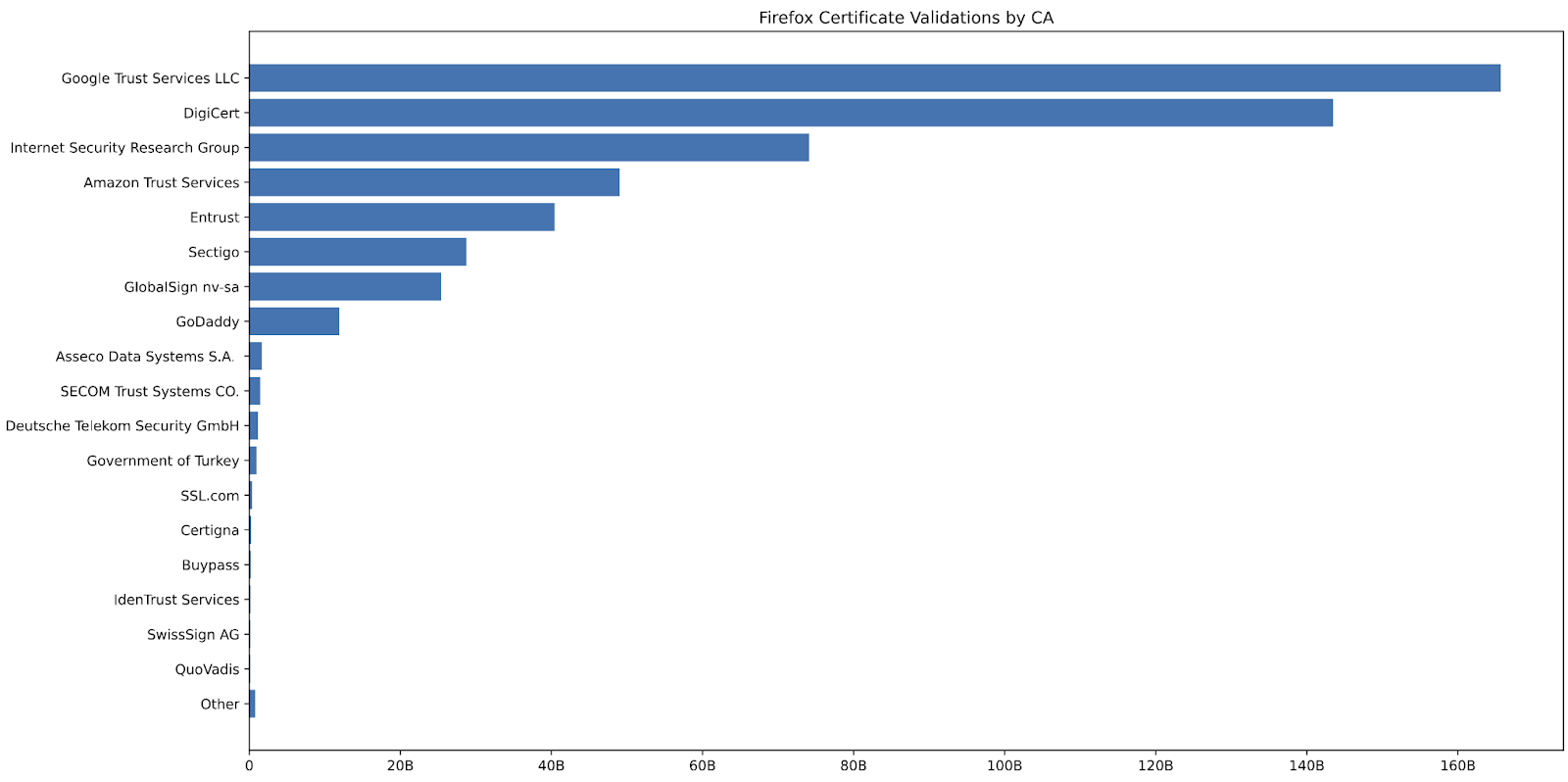
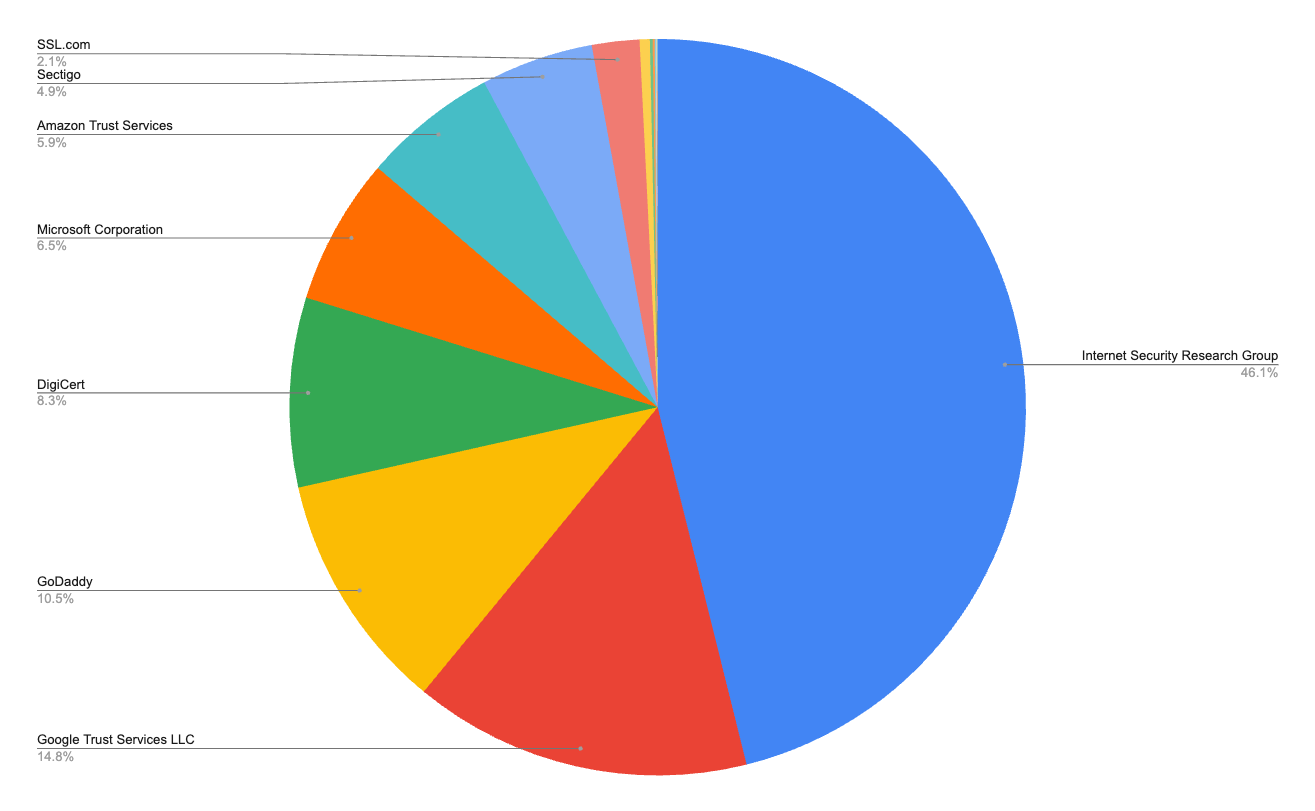
Mozilla telemetry reveals exactly what happened. Let’s Encrypt dominates issuance at 46.1% of certificates but ranks third in Firefox usage. LE democratized HTTPS for the long tail: domain parking networks, no-code builders, shared hosting platforms serving millions of low-traffic sites.

Meanwhile, high-traffic sites gravitated toward CAs like Google Trust Services (in full disclosure, I was responsible for creation of this service) that lead usage, as its used by large sites that value high availability and performance, leading to more relying party reliance despite lower issuance volumes, or established players like DigiCert and Sectigo that focus on supporting large enterprise customers. These sites need commercial support and accountability when things go wrong. The market is segmented around operational needs: the long tail valued automation over accountability, while major platforms needed enterprise support and someone to support them when something goes wrong.

Once long-tail providers flipped to HTTPS-by-default, encrypted pages became the norm. Google’s Transparency Report shows 99% of Chrome page-loads now occur over HTTPS, a transformation that began when Let’s Encrypt launched in April 2016.

The Industry Finally Admitted LE Was Right

Here’s the ultimate vindication: in 2025, the CA/Browser Forum mandated 47-day maximum certificate validity by 2029, with Chrome requiring automation from every public CA. Let’s Encrypt didn’t follow industry trends. The industry now follows Let’s Encrypt.

What seemed like LE’s “unusual” 90-day lifespans in 2016 became conservative by 2025. The mandate’s technical reasoning mirrors what LE pioneered: short-lived certificates reduce dependence on revocation checking, reduce key compromise windows, and force automated resilient infrastructure.

Leading organizations moved even further ahead. Netflix runs 30-day certificates in production, Google issues 7-day certificates for infrastructure, and Let’s Encrypt will introduce 6-day certificates by end of 2025. The mandates aren’t pushing innovation forward; they’re codifying where leaders already operate.

Why This Matters Beyond Certificates

Let’s Encrypt proved that critical internet infrastructure could be reimagined from first principles rather than optimized around legacy organizational constraints and practices. But the implications go deeper than certificate automation.

Traditional CAs were fundamentally vetting authorities with deep expertise in legal requirements for vetting people and businesses worldwide. They should have owned the remote identity verification market that exploded with digital transformation. Instead, they remained myopically focused on public trust-based certificate products while companies like Jumio and Onfido captured those opportunities. At the same time, they missed the massive expansion of machine and workload identity because they were ignoring private PKI use cases. They weren’t just leaving money on the table; they were failing to build a resilient business and neglecting the foundation for the trust infrastructure they supposedly managed.

The same organizational constraints that prevented CAs from building ACME also blinded them to adjacent markets that were natural extensions of their core competencies. They were too focused on maintaining certificate revenue streams and too constrained by existing structures to recognize how the world was shifting from hosting providers to cloud to SaaS.

ACME became the standard not because it was technically superior to existing APIs, though it was, but because it was designed for portability rather than lock-in. ARI emerged because LE experienced ecosystem pain and could fix it without navigating corporate bureaucracy or competitive concerns.

The complexity and friction we’d accepted for decades weren’t inherent to certificate management. It was the byproduct of organizational structures optimizing for vendor revenue rather than user adoption.

Today’s 47-day mandate represents more than policy evolution. It’s the industry formally acknowledging that Let’s Encrypt defined the correct approach for internet trust infrastructure. Conway’s Law isn’t destiny, but escaping it requires the courage to rebuild systems around user needs rather than organizational convenience.

WebPKI Market Analysis: Mozilla Telemetry vs Certificate Transparency Data

In the past, I’ve written about how to measure the WebPKI, and from time to time I post brief updates on how the market is evolving.

The other day, Matthew McPherrin posted a script showing how to use Mozilla telemetry data to analyze which Certificate Authorities are more critical to the web. Specifically, what percentage of browsing relies on each CA. Mozilla provides public data from Firefox’s telemetry on how many times a CA is used to successfully validate certificates. This is a pretty good measure for how “big” a CA actually is. The data is pretty hard to view in Mozilla’s public systems though, so he made a script to combine a few data sources and graph it.

I normally focus on total issuance numbers since they’re easier to obtain. That data comes from Certificate Transparency logs, which contain all publicly trusted certificates that you might encounter without seeing an interstitial warning about the certificate not being logged (like this example).

What the Data Reveals

Both datasets feature many of the same major players. But there are some striking differences that reveal important insights about the WebPKI ecosystem.

Let’s Encrypt dominates certificate issuance at 46.1% of all certificates. But it ranks third in Firefox’s actual usage telemetry. This suggests Let’s Encrypt serves many lower-traffic sites. Meanwhile, Google Trust Services leads in Firefox usage while ranking second in certificate issuance volume. This shows how high-traffic sites can amplify a CA’s real-world impact.

DigiCert ranks second in Firefox usage while placing fourth in certificate issuance volume at 8.3%. This reflects their focus on major enterprise customers. With clients like Meta (Facebook, Instagram, WhatsApp), they secure some of the world’s highest-traffic websites. This “fewer certificates, massive impact” approach drives them up the usage charts despite not competing on volume with Let’s Encrypt.

Google’s dominance reflects more than just their own properties like Google.com, YouTube, and Gmail. Google Cloud offers arguably the best load balancer solution in the market (full disclosure I worked on this project). You get TLS by default for most configurations. Combined with their global network that delivers CDN-like benefits out of the gate, this attracts major platforms like Wix and many others to build on Google Cloud. When these platforms choose Google’s infrastructure, they automatically inherit Google Trust Services certificates.

Looking at the usage data reveals other interesting patterns. Deutsche Telekom Security, Government of Turkey, (UPDATE: turns out the Turkey entry is a Firefox bug: they’re using bucket #1 for both locally installed roots and Kamu SM, apparently by accident) and SECOM Trust Systems all appear prominently in Firefox telemetry but barely register in issuance numbers. In some respects, it’s no surprise that government-issued certificates see disproportionate usage. Government websites are often mandated for use. Citizens have to visit them for taxes, permits, benefits, and other essential services.

Microsoft Corporation appears significantly in issuance data (6.5%) but doesn’t register in the Firefox telemetry. This reflects their focus on enterprise and Windows-integrated scenarios rather than public web traffic.

GoDaddy shows strong issuance numbers (10.5%) but more modest representation in browsing telemetry. This reflects their massive domain parking operations. They issue certificates for countless parked domains that receive minimal actual user traffic.

Why This Matters

Mozilla Firefox represents under 3% of global browser market share. This telemetry reflects a smaller segment of internet users. While this data provides valuable insights into actual CA usage patterns, it would be ideal if Chrome released similar telemetry data. Given Chrome’s dominant 66.85% market share, their usage data would dramatically improve our understanding of what real WebPKI usage actually looks like across the broader internet population.

The contrast between certificate issuance volume and actual browsing impact reveals important truths about internet infrastructure. CT logs currently show over 450,000 certificates being issued per hour across all CAs. Yet as this Firefox telemetry data shows, much of that volume serves lower-traffic sites while a smaller number of high-traffic certificates drive the actual user experience. Some CAs focus on high-volume, automated issuance for parked domains and smaller sites. Others prioritize fewer certificates for high-traffic, essential destinations. Understanding both metrics helps us better assess the real-world criticality of different CAs for internet security and availability.

Raw certificate counts don’t tell the whole story. The websites people actually visit, and sometimes must visit, matter just as much as the sheer number of certificates issued. Some certificates protect websites with “captive audiences” or essential services, while others protect optional destinations. A government tax portal or YouTube will always see more traffic than the average small business website, regardless of how many certificates each CA issues.

Regardless of how you count, I’ve had the pleasure of working closely with at least 7 of the CAs in the top 10 in their journeys to become publicly trusted CAs. Each of these CAs have had varying goals for their businesses and operations, and that’s exactly why you see different manifestations in the outcomes. Let’s Encrypt focused on automation and volume. DigiCert targeted enterprise customers. Google leveraged their cloud infrastructure. GoDaddy built around domain services.

Either way, it’s valuable to compare and contrast these measurement approaches to see what the WebPKI really looks like beyond just raw certificate counts.

Conway’s Law Is Dying

I’ve been thinking about Conway’s Law, the idea that organizations “ship their org chart.” The seams are most visible in big tech. Google, for example, once offered nearly a dozen messaging apps instead of a single excellent one, with each team fighting for resources. The same pattern appears everywhere: companies struggle to solve problems that cross organizational boundaries because bureaucracy and incentives keep everyone guarding their turf. The issue is not the technology; it is human nature.

I caught up with an old friend recently. We met at nineteen while working for one of the first cybersecurity companies, and now, in our fifties, we both advise organizations of every size on innovation and problem-solving. We agreed that defining the technical fix is the easy part; the hard part is steering it through people and politics. When change shows up, most organizations behave like an immune system attacking a foreign antibody. As Laurence J. Peter wrote in 1969, “Bureaucracy defends the status quo long past the time when the quo has lost its status.”

Naturally, the conversation drifted to AI and how it will, or will not, transform the companies we work with. I explored this in two recent posts [1,2]. We have seen the same thing: not everyone is good at using AI. The CSOs and CTOs we speak with struggle to help their teams use the technology well, while a handful of outliers become dramatically more productive. The gap is not access or budget; it is skill. Today’s AI rewards people who can break problems down, spot patterns, and think in systems. Treat the model like a coworker and you gain leverage; treat it like a tool and you barely notice a difference.

That leverage is even clearer for solo founders. A single entrepreneur can now stretch farther without venture money and sometimes never need it. With AI acting as marketer, product manager, developer, and support rep, one person can build and run products that once demanded whole teams. This loops back to Conway’s Law: when you are the entire org chart, the product stays coherent because there are no turf battles. Once layers of management appear, the seams show, and people ship their structure. Peter’s Principle follows, people rise to their level of incompetence, and the bureaucracy that emerges defends that status.

Yet while AI empowers outliers and small players, it might also entrench new kinds of monopolies. Big tech, with vast data and compute resources, could still dominate by outscaling everyone else, even if their org charts are messy. The question becomes whether organizational dysfunction will outweigh resource advantages, or whether sheer scale still wins despite structural problems.

The traditional buffers that let incumbents slumber (high engineering costs, feature arms races, and heavy compliance overhead) are eroding. Payroll keeps rising and headcount is the biggest line item, while the newest startups need fewer people every quarter. I expect a new wave of private-equity-style moves: smaller players snapped up, broken into leaner parts, and retooled around AI so they no longer rely on large teams.

Social media voices such as Codie Sanchez highlight the largest generational transfer of wealth in history. Many family-owned firms will soon be sold because their heirs have no interest in running them. These so-called boring businesses may look ripe for optimization, because most still rely on human capital to keep the lights on. Just above that tier we see larger enterprises weighed down by armies of people who perform repetitive tasks. A modern consulting firm armed with AI could walk into any of these firms and automate vast swaths of monotonous work that keeps those businesses running. Incumbents will struggle to move that fast, trapped by the very structures we have been discussing. A private-equity buyer, on the other hand, can apply the playbook with no sentimental ties and few political constraints.

ATMs let banks cut tellers and close branches. Customers later missed human service, so smaller neighborhood offices came back. AI will force every sector to strike its own balance between efficiency and relationship.

They say history doesn’t rhyme but it repeats, if so incumbents who dismiss AI as hype may follow Blockbuster into the museum of missed opportunities. In Wall Street (1987), Michael Douglas plays Gordon Gekko, a corporate raider who uses leveraged buyouts to seize firms like Blue Star Airlines, an aircraft maintenance and charter company. Gekko’s playbook, acquire, strip assets, slash jobs, was ruthless but effective, exploiting inefficiencies in bloated structures. Today, AI plays a similar role, not through buyouts but by enabling leaner, faster competitors to gut inefficiencies. Solo founders and AI-driven startups can now outpace large teams, while private-equity buyers use AI to retool acquired firms, automating repetitive tasks and shrinking headcounts. Just as Gekko hollowed out firms in any industry, AI’s relentless optimization threatens any business clinging to outdated, bureaucratic org charts.

Across news, television, music, and film, incumbents once clung to their near-monopoly positions and assumed they had time to adapt. Their unwillingness to face how the world was changing, and their instinct to defend the status quo, led to the same result: they failed to evolve and disappeared when the market moved on.

The Ask? incumbents, you need to automate before raiders do it for you.

What Does CPA Canada Have to Do With the WebPKI Anyway?

When we discuss the WebPKI, we naturally focus on Certificate Authorities (CAs), browser root programs, and the standards established by the CA/Browser Forum. Yet for these standards to carry real weight, they must be translated into formal, auditable compliance regimes. This is where assurance frameworks enter the picture, typically building upon the foundational work of the CA/Browser Forum.

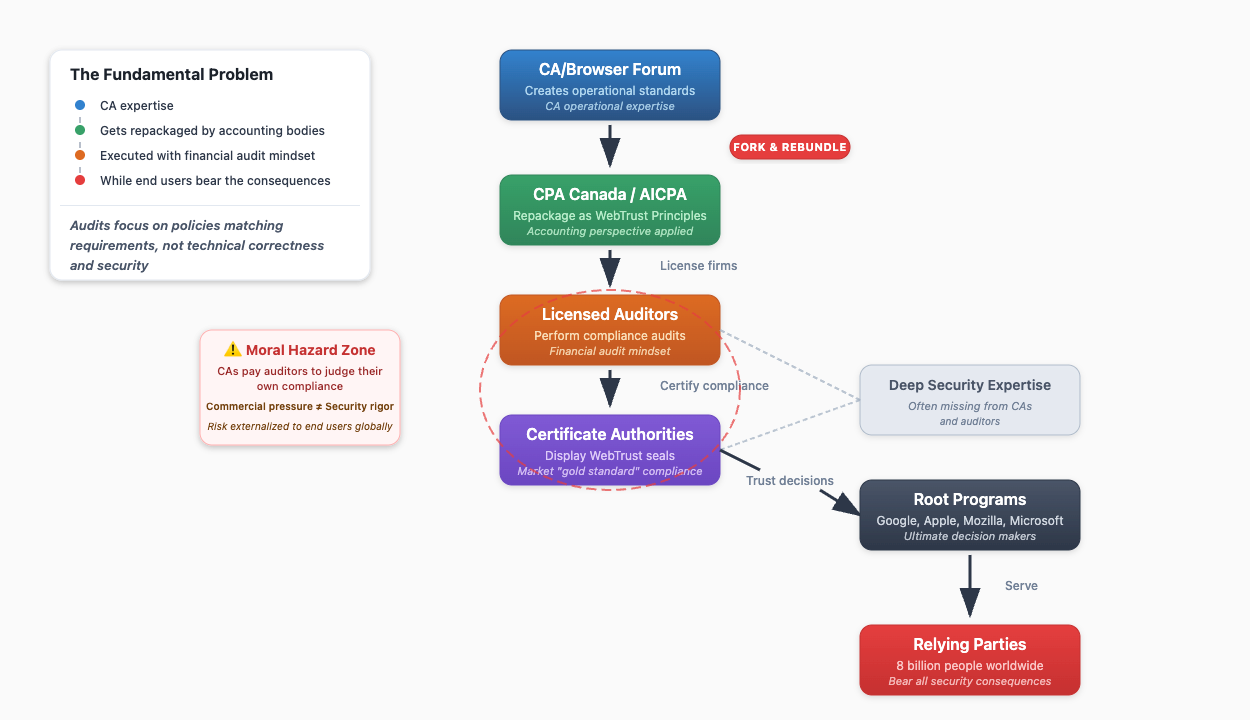
The WebTrust framework, overseen by professional accounting bodies, is only one way to translate CA/Browser Forum requirements into auditable criteria. In Europe, a parallel scheme relies on the European Telecommunications Standards Institute (ETSI) for the technical rules, with audits carried out by each country’s ISO/IEC 17065-accredited Conformity Assessment Bodies. Both frameworks follow the same pattern: they take the CA/Browser Forum standards and repackage them into structured compliance audit programs.

Understanding the power dynamics here is crucial. While these audits scrutinize CAs, they exercise no direct control over browser root programs. The root programs at Google, Apple, Microsoft, and Mozilla remain the ultimate arbiters. They maintain their own policies, standards, and processes that extend beyond what these audit regimes cover. No one compels the browsers to require WebTrust or ETSI audits; they volunteer because obtaining clean reports from auditors who have seen things in person helps them understand if the CA is competent and living up to their promises.

How WebTrust Actually Works

With this context established, let’s examine the WebTrust model prevalent across North America and other international jurisdictions. In North America, administration operates as a partnership between the AICPA (for the U.S.) and CPA Canada. For most other countries, CPA Canada directly manages international enrollment, collaborating with local accounting bodies like the HKICPA for professional oversight.

These organizations function through a defined sequence of procedural steps: First, they participate in the CA/Browser Forum to provide auditability perspectives. Second, they fork the core technical requirements and rebundle them as the WebTrust Principles and Criteria. Third, they license accounting firms to conduct audits based on these principles and criteria. Fourth, they oversee licensed practitioners through inspection and disciplinary processes.

The audit process follows a mechanical flow. CA management produces an Assertion Letter claiming compliance. The auditor then tests that assertion and produces an Attestation Report, a key data point for browser root programs. Upon successful completion, the CA can display the WebTrust seal.

This process creates a critical misconception about what the WebTrust seal actually signifies. Some marketing approaches position successful audits as a “gold seal” of approval, suggesting they represent the pinnacle of security and best practices. They do not. A clean WebTrust report simply confirms that a CA has met the bare minimum requirements for WebPKI participation, it represents the floor, not the ceiling. The danger emerges when CAs treat this floor as their target; these are often the same CAs responsible for significant mis-issuances and ultimate distrust by browser root programs.

Where Incentives Break Down

Does this system guarantee consistent, high-quality CA operations? The reality is that the system’s incentives and structure actively work against that goal. This isn’t a matter of malicious auditors; we’re dealing with human nature interacting with a flawed system, compounded by a critical gap between general audit principles and deep technical expertise.

Security professionals approach assessments expecting auditors to actively seek problems. That incentive doesn’t exist here. CPA audits are fundamentally designed for financial compliance verification, ensuring documented procedures match stated policies. Security assessments, by contrast, actively hunt for vulnerabilities and weaknesses. These represent entirely different audit philosophies: one seeks to confirm documented compliance, the other seeks to discover hidden risks.

This philosophical gap becomes critical when deep technical expertise meets general accounting principles. Even with impeccably ethical and principled auditors, you can’t catch what you don’t understand. A financial auditor trained to verify that procedures are documented and followed may completely miss that a technically sound procedure creates serious security vulnerabilities.

This creates a two-layer problem. First, subtle but critical ambiguities or absent content in a CA’s Certification Practice Statement (CPS) and practices might not register as problems to non-specialists. Second, even when auditors do spot vague language, commercial pressures create an impossible dilemma: push the customer toward greater specificity (risking the engagement and future revenue), or let it slide due to the absence of explicit requirements.

This dynamic creates a classic moral hazard, an issue similar to the one we explored in our recent post, Auditors are paid by the very entities they’re supposed to scrutinize critically, creating incentives to overlook issues in order to maintain business relationships. Meanwhile, the consequences of missed problems, security failures, compromised trust, and operational disruptions fall on the broader WebPKI ecosystem and billions of relying parties who had no voice in the audit process. This dynamic drives the inconsistencies we observe today and reflects a broader moral hazard problem plaguing the entire WebPKI ecosystem, where those making critical security decisions rarely bear the full consequences of poor choices.

This reality presents a prime opportunity for disruption through intelligent automation. The core problem lies in expertise “illiquidity”, deep compliance knowledge remains locked in specialists’ minds, trapped in manual processes, and is prohibitively expensive to scale.

Current compliance automation has only created “automation asymmetry,” empowering auditees to generate voluminous, polished artifacts that overwhelm manual auditors. This transforms audits from operational fact-finding into reviews of well-presented fiction.

The solution requires creating true “skill liquidity” through AI: not just another LLM, but an intelligent compliance platform embedding structured knowledge from seasoned experts. This system would feature an ontology of controls, evidence requirements, and policy interdependencies, capable of performing the brutally time-consuming rote work that consumes up to 30% of manual audits: policy mapping, change log scrutiny, with superior speed and consistency.

When auditors and program administrators gain access to this capability, the incentive model fundamentally transforms. AI can objectively flag ambiguities and baseline deviations that humans might feel pressured to overlook or lack the skill to notice, directly addressing the moral hazard inherent in the current system. When compliance findings become objective data points generated by intelligent systems rather than subjective judgments influenced by commercial relationships, they become much harder to ignore or rationalize away.

This transformation liquefies rote work, liberating human experts to focus on what truly matters: making high-stakes judgment calls, investigating system-flagged anomalies, and assessing control effectiveness rather than mere documented existence. This elevation transforms auditors from box-checkers into genuine strategic advisors, addressing the system’s core ethical challenges.

This new transparency and accountability shifts the entire dynamic. Audited entities can evolve from reactive fire drills to proactive, continuous self-assurance. Auditors, with amplified expertise and judgment focused on true anomalies rather than ambiguous documentation, can deliver exponentially greater value.

Moving Past the Performance

This brings us back to the fundamental issue: the biggest problem in communication is the illusion that it has occurred. Today’s use of the word “audit” creates a dangerous illusion of deep security assessment.

By leveraging AI to create skill liquidity, we can finally move past this illusion by automating the more mundane audit elements giving space where the assumed security and correctness assessments also happen. We can forge a future where compliance transcends audit performance theater, becoming instead a foundation of verifiable, continuous operational integrity, built on truly accessible expertise rather than scarce, locked-away knowledge.

The WebPKI ecosystem deserves better than the bare minimum. With the right tools and transformed incentives, we can finally deliver it.